Understand Romania
Myths and Legends
56 cards · 52 + 4 jokers
Culture playing cards · First edition 2026
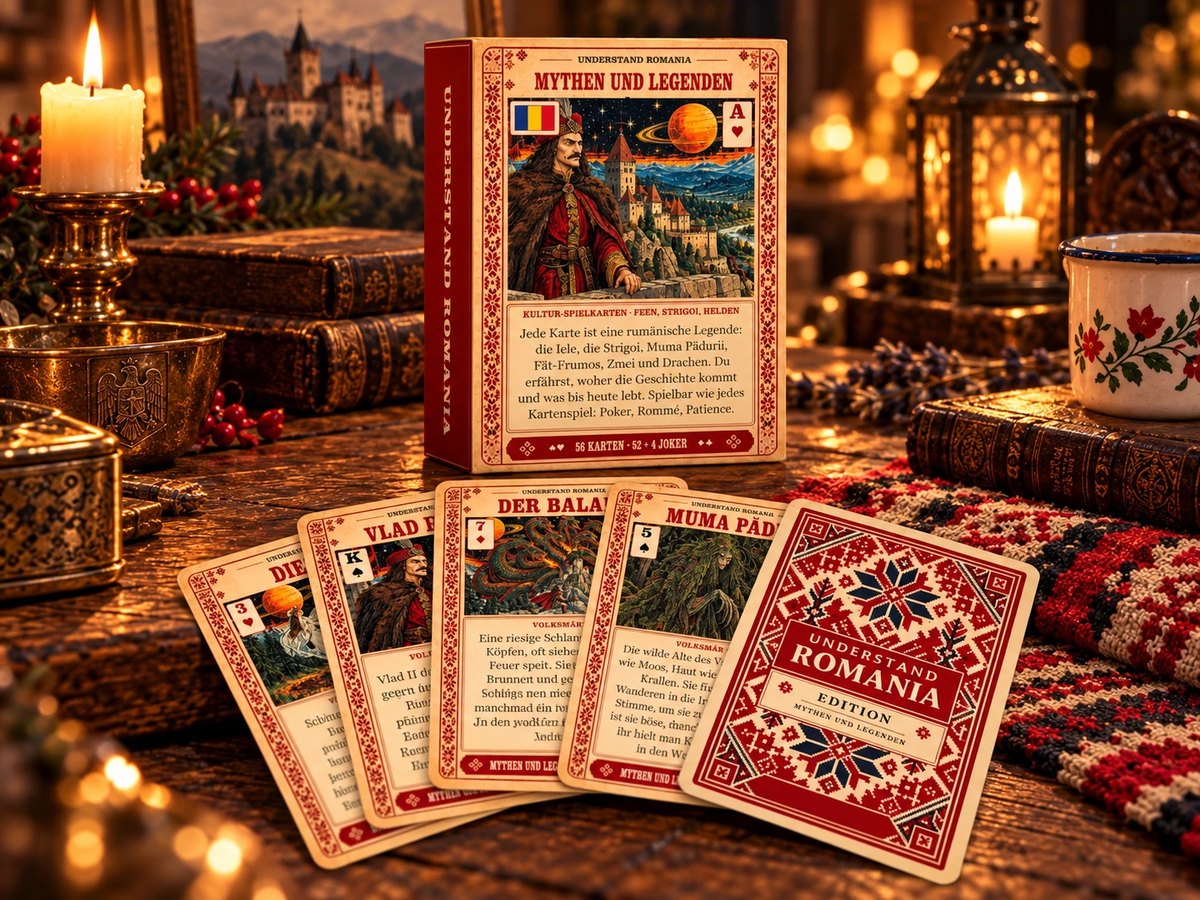
Every card is a Romanian legend: the Iele, the strigoi, Muma Pădurii, Făt-Frumos, zmei and dragons. Learn where each story comes from and what lives on today.
Front and back
All cards
All the stories (47)
- ILEANA COSÂNZEANA — folk tale. The most beautiful girl in Romanian fairy tales: “you could look at the sun, but not at her”. To win her, Făt-Frumos goes through trials and fights dragons and monsters. Her name may come from the Sânziene, the fairies of summer. For Romanians she is the image of beauty and kindness.
- ZBURĂTORUL — folk belief · Heliade Rădulescu, 1843. A spirit of love who comes at night, like a flame or a fiery serpent, to young girls. The girl he visits grows pale, dreams and finds no peace. Ion Heliade Rădulescu wrote the poem “Zburătorul” about him in 1843. Old women said this explained the longing of first love.
- THE IELE — folk belief. Beautiful and dangerous fairies who dance at night in the air above forest clearings. Where they dance, the grass stays burnt in a ring. Whoever sees them or hears their song may be “taken by the Iele”: paralysed or out of their mind. Their name was never spoken; people called them “They” or “the Fair Ones”.
- SÂNZIENELE — night of 23 to 24 June. On the night of Sânziene, the good fairies of summer dance in the fields and give power to flowers and healing herbs. Girls weave crowns of yellow lady's bedstraw and throw them onto the roof: if the crown stays up, they will marry that year. The feast comes from the summer solstice and is still kept today.
- THE URSITOARE — folk belief. On the third night after a birth, three fates come to the baby's cradle and decide its destiny. One spins the thread of life, one winds it, the third cuts it. The family leaves bread, salt and wine on the table to keep them kind. What they have decided can never be changed.
- DRĂGAICA — 24 June · Muntenia and Oltenia. Drăgaica is the fairy of ripe fields. On 24 June, a girl chosen by the village, crowned with ears of wheat, walks with other girls through the fields and sings so that the wheat will be rich. Whoever does not honour the day may be punished by her. The custom is close to Sânziene and belongs to midsummer.
- DRAGOBETELE — 24 February. Son of Baba Dochia, young god of love and spring. On 24 February, when “the birds get engaged”, girls and boys went into the forest for snowdrops and ran back: the boy who caught a girl could kiss her. Whoever keeps Dragobete will be loved all year. Today it is called the Romanian Valentine's Day.
- MĂRȚIȘOR — 1 March · UNESCO heritage since 2017. On 1 March people give a twisted red and white string with a small charm. Red and white stand for winter and spring, for life and purity. It is worn for a few days or all of March, then hung on a blossoming tree. In 2017, UNESCO added the custom to its heritage list.
- LUCEAFĂRUL — Mihai Eminescu, 1883. The evening star comes down from the sky out of love for an emperor's daughter, Cătălina. To be with her, he asks God to make him mortal. But the girl chooses Cătălin, an earthly page. Eminescu's poem of 1883 has 98 stanzas and is the best-known poem of Romanian literature.
- THE RUSALII — 50 days after Easter. Female spirits who roam the earth in the week of Pentecost. At night they fly over waters and fields and harm those who work on their days. People wear wormwood at the waist and put it in the windows. The Călușari dance is linked to them; it was said to heal those “taken by the Rusalii”.
- THE MOUNTAIN FAIRY — legends of the Carpathians. Queen of the mountains and of wild animals. She guards springs, forests and flocks, and shepherds leave her a bowl of milk at the sheepfold. Those who cut the forest for nothing or kill animals without need are led astray in the fog. Many lakes and peaks in the Carpathians have a story about her.
- THE SNOWDROP LEGEND — folk legend. Old Winter did not want to leave and buried Spring under the snow as she tried to come out of the ground. Spring scratched her fingers, and from the drops of her blood grew the first snowdrops, white and brave. Since then the snowdrop is the first flower to break through the snow and announce that winter is over.
- EDELWEISS — Carpathians · protected flower. The white flower of the highest cliffs. Young men climbed the rocks to pick it for the girl they loved, as proof of courage, and some never came back. Legend says it is the tear of a mountain fairy. Today edelweiss is protected and picking it is forbidden.
- STRIGOI — folk belief. The restless dead who leave their graves at night to torment their families and cattle. Children born with a caul, the seventh child or those buried without a candle could become strigoi. Against them: garlic at doors and windows, incense and, if needed, a stake through the heart. Bram Stoker drew on these beliefs.
- MOROI — folk belief. The souls of children who died unbaptised and come home at night. They cry, ask to be baptised and drain the strength of the living, above all of their mothers. Dogs sense them and bark into the dark. To give them peace, people named them and gave alms in their memory.
- VÂRCOLACI — eclipses in folk belief. Giant beasts that climb to the sky and bite the Moon or the Sun. This is how old people explained eclipses. To scare them away, people banged trays, bells and pots and fired guns. Cursed children, or women who spun at night without a candle, could become vârcolaci.
- PRICOLICI — folk belief. A man who turns into a wolf or a huge dog at night. After death, those who were wicked in life become pricolici. They attack cattle and lost travellers, and by day look like any other man. It is the Romanian werewolf and the hero of many winter tales told by the stove.
- MUMA PĂDURII — folk tales. The wild old woman of the forest, with hair like moss, skin like bark and long claws. She leads children and travellers astray and changes her voice to lure them. Sometimes she is evil, sometimes she protects the forest from those who harm it. Children were told about her so they would not go into the woods alone.
- BABA CLOANȚA — folk tales. The ugly witch of fairy tales, with a single tooth and a hooked nose. She boils herbs and bones in her cauldron, casts spells and turns into animals. Heroes must trick her to win back their horse or their bride. In Romanian her name has come to mean a wicked old woman.
- SOLOMONARI — folk belief. Wizards who study for seven years in a school under the earth. They ride dragons through the clouds and bring rain or hail upon villages. They walk through the villages in rags and beg: whoever refuses them sees his fields beaten by hail. They own a book in which all the knowledge of the world is written.
- SAMCA — folk belief. A female demon who visits pregnant women and newborns. She brings fever, fright and even death. Old women drove her away with charms and amulets on which her 19 names were written. Whoever knows all her names, the belief says, is safe from her.
- JOIMĂRIȚA — Holy Thursday · Moldavia and Bukovina. The old woman who walks through the villages on Holy Thursday, before Easter. She checks whether the girls have spun all their hemp from the winter. Lazy ones are punished: she burns their fingers or spoils their work. For fear of her, girls worked all through Lent to finish on time.
- THE PLAGUE MAIDEN — folk belief · time of epidemics. The plague was imagined as a tall, pale woman in white walking alone through the villages. She knocks on doors and calls people by name: whoever answers falls ill. So in times of plague, nobody answered when called at night. Wherever she passed, villages were left empty.
- NECURATUL — folk belief. In Romanian folklore the devil has dozens of names that avoid saying his real one: the Unclean, Aghiuță, the One on the Treasure. He appears as a gentleman in black at crossroads at midnight. He offers money or luck in exchange for your soul. In the tales, the clever peasant usually outwits him.
- HOIA-BACIU FOREST — near Cluj-Napoca. The forest near Cluj is called the “Bermuda Triangle of Transylvania”. The trees have twisted, bent trunks, and in the middle lies a round clearing where almost nothing grows. Locals tell of people who vanished and of strange lights. Since the 1960s, people interested in the paranormal have come here.
- VLAD THE IMPALER — Prince of Wallachia, 1456 – 1462. Vlad III, son of Vlad Dracul, fought the Ottoman Empire and punished thieves and traitors without mercy by impaling them. In 1462 he attacked the camp of Sultan Mehmed II at night. For Romanians he is a just and harsh ruler. His fame as a vampire came only with Bram Stoker in 1897.
- FĂT-FRUMOS — fairy-tale hero. The best-known hero of Romanian fairy tales: young, handsome, brave and pure of heart. He rides out into the world on his magic horse, fights dragons and monsters and rescues Ileana Cosânzeana. In some tales he is born from a tear. His story shows that good wins, but only after many trials.
- PRÂSLEA THE BRAVE — tale collected by Petre Ispirescu. The youngest of the emperor's three sons. Every year a zmeu stole the golden apples from the garden. The elder brothers fall asleep on guard; only Prâslea stays awake and wounds the zmeu. He then goes down to the other world, kills the zmei and rescues three princesses. His brothers betray him, but the truth comes out.
- GREUCEANU — tale collected by Petre Ispirescu. The zmei stole the Sun and the Moon, and the world was left in darkness. Greuceanu sets out to bring them back. He kills two zmei, tricks their wives and escapes their mother, the worst of all. In the end he throws the Sun and the Moon back into the sky. It is one of the oldest stories of light and darkness.
- HARAP-ALB — Ion Creangă, 1877. The king's son sets out to his uncle, the Green Emperor, and takes the Beardless Man as servant, who tricks him and takes his place. The prince becomes his servant, named Harap-Alb. With the help of five strange friends he passes every test and wins the daughter of the Red Emperor. Every Romanian pupil reads Creangă's tale.
- SPÂNUL — Ion Creangă, “The Story of Harap-Alb”. The beardless man, sly and wicked, whom the king warned his son to avoid. The son meets him three times; then the Beardless Man traps him in a well and takes his letter, his horse and his name. In Romanian, “spânul” still means someone who deceives you with a smile.
- THE ZMEU — folk tales. The most feared creature of Romanian tales: a giant, hairy man with a mace who lives in the other world. He steals princesses, the Sun, the Moon or the golden apples. He throws his mace home before he arrives. Unlike a dragon, the zmeu talks, marries and has a mother who is just as evil.
- THE BALAUR — folk tales. A giant serpent with several heads, often seven or twelve, that breathes fire. It guards treasures, wells and stolen girls. Sometimes, when one head is cut off, another grows in its place. Saint George and Făt-Frumos are the heroes who defeat it. In the clouds, balauri are driven by the solomonari.
- THE MAGIC HORSE — folk tales. The horse that talks and flies “like the wind and like thought”. At first it looks like a bony old nag, but after eating glowing embers it becomes the most beautiful horse. It advises the hero and saves him from every trouble. Without it, neither Făt-Frumos nor Harap-Alb would have achieved anything.
- PASĂREA MĂIASTRĂ — fairy tale · Constantin Brâncuși. The enchanted bird of fairy tales, with golden feathers, whose song heals the sick. Heroes travel to the end of the world to find her. Constantin Brâncuși began sculpting her in 1910 and made her a symbol of flight. His birds are now in the great museums of the world.
- SFARMĂ-PIATRĂ — tale collected by Petre Ispirescu. The giant who crushes rocks in his hands. With his brothers, Strâmbă-Lemne, who bends trees, and Fărâmă-Munte, he sets out to fight the zmei. They are loyal friends, but not very clever. The story shows that strength without wits is not enough and that even the strongest needs friends.
- DECEBALUS' TREASURE — 106 AD · Cassius Dio. The historian Cassius Dio writes that Decebalus diverted the river Sargetia, buried his treasure in its bed and then let the water flow over it again. The slaves who dug were killed so they could tell no one. A close companion, Bicilis, betrayed the king, and the Romans found the gold. Many still search the mountains for Dacian treasure.
- DETUNATA — Apuseni Mountains · natural monument. A mountain of huge basalt columns, like organ pipes, in the Apuseni. Legend says the devil built his house here and God struck it with lightning: hence the name, “the Thunder-struck”. Geologists know the basalt formed from cooled lava millions of years ago. Today it is a natural monument.
- THE RED LAKE — Harghita · formed in 1837. The lake formed in 1837 when a mountainside collapsed and blocked the river. Trunks of dead fir trees still stick out of the water. In places the water looks reddish from iron oxides. Legend says a girl, Eszter, was carried off by a robber and died there, and the mountain fell on them both.
- BRAN CASTLE — Brașov · built 1377 – 1388. The fortress at the pass between Wallachia and Transylvania, built by the Saxons of Brașov. The world knows it as “Dracula's Castle”, although Vlad the Impaler never lived here. In 1920 it was given to Queen Marie. Today it is the most visited castle in Romania.
- NOVAC'S FURROW — Oltenia and Muntenia. An earthwork hundreds of kilometres long running across Oltenia and Muntenia. Legend says the giant Novac caught a dragon, yoked it to a plough and dragged the furrow until the dragon died of exhaustion. Historians believe these are Roman defensive walls from the 4th century.
- STEPHEN THE GREAT'S MOTHER — Neamț Fortress, 1476 · Dimitrie Bolintineanu. After the battle of Războieni in 1476, the wounded Stephen the Great reaches the gates of Neamț fortress. His mother will not open: “Go back to your army and die for your country.” Stephen turns back, raises a new army and drives out the Turks. Generations of pupils learned Bolintineanu's poem by heart.
- THE BEAR CAVE — Chișcău, Bihor · discovered in 1975. The cave was discovered in 1975 when workers blasted a marble quarry. Inside lay more than 140 skeletons of cave bears, a species extinct for tens of thousands of years. Its stalactites and stalagmites make it one of the most beautiful caves in Europe.
- DRACULA — Bram Stoker, 1897. The vampire count from Bram Stoker's novel, published in London in 1897. Stoker never visited Romania: he read about Transylvania and borrowed the name of Vlad Dracula. The novel inspired hundreds of films and made Transylvania, in the eyes of the world, the land of vampires.
- THE CĂPCĂUNI — folk belief. Giants with dogs' heads and a single eye in the forehead who eat people. In the tales they come from foreign lands and lay villages waste. In Romanian, “căpcăun” still means a greedy, cruel person. Some historians think the memory goes back to invaders from the east.
- THE GIANTS — folk legends. The people before us, old folk say, were giants as tall as mountains. They moved rocks, crossed rivers in a single step and threw stones from one hill to another. The strange rocks in the mountains are said to be their toys. They perished because they were proud and would not bow to God. After them came the small people: us.
- ZORILĂ, MURGILĂ AND MIEZILĂ — folk mythology. Three brothers who share the day between them. Zorilă, on a white horse, brings the morning. Murgilă, on a bay horse, brings the evening. Miezilă, on a black horse, brings midnight. In the tales, heroes meet them on the road and sometimes tie them up to stop time. This is how old people explained to children why day turns into night.
Pre-order yours
Game: Myths and Legends
- You pay nothing now.
- We make first what most people ask for.
- Then you get one e-mail from us — and decide.
- Printed in Romania, in small editions. We insist on it.