Understand Romania
Timișoara
54 cards · 52 + 2 jokers
Culture playing cards · First edition 2026
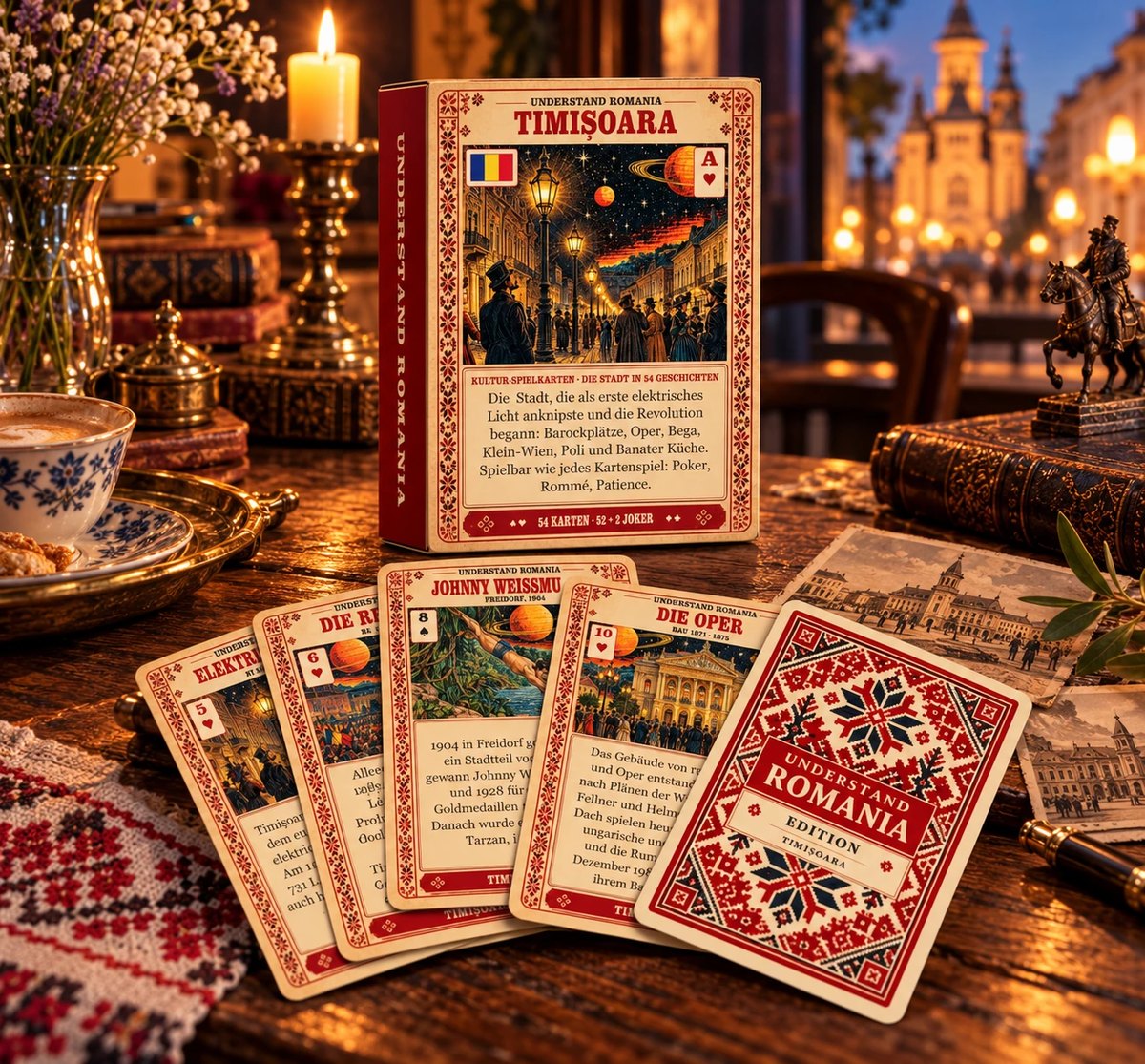
The city that first switched on electric light and started the Revolution: Baroque squares, the Opera, the Bega, Little Vienna, Poli and Banat cuisine, in 54 true stories. Play any game: poker, rummy, solitaire.
Front and back
All cards
All the stories (54)
- VICTORY SQUARE — Opera · Cathedral. The heart of the city stretches between the Opera and the Metropolitan Cathedral. On 20 December 1989, from the Opera balcony, Timișoara was declared the first free city of Romania. Today it is the place for walks, cafés and big celebrations.
- METROPOLITAN CATHEDRAL — built 1936 – 1946. The tallest building in the centre, with a roof of glazed tiles in green, red and yellow patterns. It blends Byzantine and Moldavian styles. In December 1989, young people demanding freedom died on its steps.
- UNION SQUARE — Baroque · 18th century. The oldest square in the city, surrounded by colourful Baroque palaces. Here stand the Roman Catholic Dome and the Baroque Palace, and in the middle the Holy Trinity Column, raised after the plague of 1738. Many call it the most beautiful Baroque square in Romania.
- THE BEGA — navigable canal · 18th century. The Habsburgs regulated the river in the 18th century and turned it into a navigable canal that carried grain and timber to the Danube. Today the banks of the Bega are parks, terraces and cycle paths, and in summer small boats sail the canal again.
- ELECTRIC LIGHT — 12 November 1884. Timișoara was the first city in mainland Europe with electrically lit streets. On 12 November 1884, 731 lamps were switched on. The city also had Romania's first horse-drawn tram in 1869, and electric trams from 1899.
- THE REVOLUTION — 16 – 20 December 1989. It all began on 16 December 1989, when people protected the pastor László Tőkés. The protest grew, the army opened fire, but the city did not stop. On 20 December, Timișoara declared itself the first free city of Romania. From here the revolution spread across the country.
- THE BASTION — Habsburg fortress · 18th century. The last large part of the star-shaped fortress built by the Habsburgs in the 18th century. Its brick walls and vaults now house museums, workshops and bars. The rest of the fortress was torn down around 1900 so the city could grow.
- CULTURAL CAPITAL — European Capital of Culture 2023. In 2023 Timișoara was European Capital of Culture, with the motto “Shine your light – Light up your city!”. A whole year of exhibitions, concerts and festivals brought hundreds of thousands of visitors and new life to many old buildings.
- CITY OF GARDENS — Rose Park · 1891. Timișoara is called the “city of flowers” for its parks along the Bega. The best known is the Rose Park, opened in 1891, with thousands of roses. In spring and summer it hosts open-air concerts and festivals.
- THE OPERA — building 1871 – 1875. The National Theatre and Opera building was built between 1871 and 1875 by the Viennese architects Fellner and Helmer. Under one roof it houses the Romanian, Hungarian and German theatres and the Romanian Opera. In December 1989 the crowd was addressed from its balcony.
- LLOYD PALACE — 1910 – 1912. The Secession-style palace on Victory Square was built between 1910 and 1912 for the Lloyd grain exchange. Its richly decorated facade is one of the most beautiful in the city. Today it houses the rectorate of the Politehnica University and a restaurant with a terrace.
- THE FORTRESS SYNAGOGUE — 1863 – 1865. The Moorish-style synagogue with stripes of red and yellow brick was built between 1863 and 1865. It shows how important the Jewish community was for the city. It has been restored and reopened as a cultural venue.
- HUNYADI CASTLE — 14th century. The oldest building in the city. King Charles Robert of Anjou built a palace here in the early 14th century, and John Hunyadi rebuilt it as a fortress in the 15th century. Later it housed the Banat Museum.
- 1716 — the Habsburg conquest. After 164 years of Ottoman rule, Prince Eugene of Savoy took Timișoara in October 1716. The Habsburgs rebuilt the city: a new star-shaped fortress, straight streets, Baroque squares and settlers brought from all over the empire.
- MILLENNIUM CHURCH — 1896 – 1901. The Roman Catholic church in the Fabric district was built between 1896 and 1901 to mark 1,000 years since the Hungarians arrived in the Carpathian Basin. With its two tall towers it dominates Romanilor Square.
- THE BREWERY — since 1718. Timișoara's brewery was founded in 1718, just two years after the Habsburgs arrived. It is the oldest brewery in Romania and still brews today.
- NORTH STATION — first train · 1857. The first train reached Timișoara in 1857, on the line from Szeged. The station building was badly damaged by the bombing of 1944 and rebuilt after the war. Trains still leave from here for Bucharest, Budapest and Belgrade.
- BANAT VILLAGE MUSEUM — Green Forest. A whole village in the open air, in the Green Forest: farmhouses, a wooden church, mills and workshops brought from all over the Banat. It shows how Romanians, Swabians, Hungarians and Serbs lived side by side in Banat villages.
- LITTLE VIENNA — Secession · 1900 – 1914. Timișoara is called “Little Vienna” for its Secession palaces built between 1900 and 1914, many designed by the architect László Székely. Trams, cafés and wide boulevards gave the city the air of an imperial capital.
- CITY OF MANY LANGUAGES — Romanians, Hungarians, Germans, Serbs. For centuries Romanians, Hungarians, Swabian Germans, Serbs, Jews and Bulgarians have lived here together. The city has theatre in three languages and newspapers in several. For many, Timișoara is the model of Banat's way of living together.
- JOHNNY WEISSMULLER — Freidorf, 1904. Born in 1904 in Freidorf, now a district of Timișoara, Johnny Weissmuller won five Olympic gold medals in swimming in 1924 and 1928. Then he became a Hollywood star: Tarzan, in 12 films.
- POLITEHNICA — founded 1920. The Politehnica University was founded in 1920 and has trained generations of engineers. Thanks to it, Timișoara became one of Romania's most important centres of engineering and IT.
- POLI TIMIȘOARA — football · since 1921. The Politehnica football club was founded in 1921. Its colours, white and violet, are seen all over the city. The fans of the “violets” are known for the atmosphere at the Dan Păltinișanu stadium.
- IOSEFIN — water tower · 1914. The district is named after Emperor Joseph II. Its symbol is the water tower, completed in 1914, which supplied the surrounding districts with water. Colourful houses and the tram give it an old-time feel.
- CENTRAL PARK — 19th century. The park grew up in the 19th century on the open ground in front of the fortress. It has old trees, shady alleys and statues. It is one of the many parks that earned Timișoara the name “city of flowers”.
- LIBERTY SQUARE — Old Town Hall · 1734. Here stands the Old Town Hall, built in 1734, the city's first seat after the Habsburgs arrived. In the middle of the square is the statue of the Virgin Mary and Saint Nepomuk from 1756. For a long time the square was used for military parades.
- BANAT CUISINE — many peoples, one table. All the city's peoples meet on the Banat table: chicken soup with noodles, Hungarian paprikash, Swabian cakes and Serbian dishes. And for guests, the table is never too full.
- TRAIAN SQUARE — heart of the Fabric district. The main square of the Fabric district, surrounded by Secession buildings from the early 20th century. Merchants, craftsmen and workers from the factories on the Bega met here. For the 2023 Capital of Culture, many facades were restored.
- NEPTUNE BATHS — built in 1914. The Secession-style public baths on the bank of the Bega were built in 1914, with little towers and richly decorated facades. People once came here to bathe, take saunas and water cures. The building shows how modern the city was before the First World War.
- BRIDGES OF THE BEGA — the city on the canal. Dozens of bridges of iron, stone and concrete cross the Bega, each with its own story. In the evening their lights are reflected in the water. The banks between the bridges have become the favourite place of locals for walks and terraces.
- THE TRAM — horse-drawn from 1869, electric from 1899. In 1869 Timișoara had Romania's first horse-drawn tram. From 1899 the electric tram ran. Trams connected the districts of Cetate, Fabric, Iosefin and Elisabetin and are still part of city life today.
- SERBIAN CATHEDRAL — 1745 – 1748. The Serbian Orthodox cathedral on Union Square was built between 1745 and 1748 in Baroque style. It is the seat of the Serbian bishopric and shows how old and important the Serbian community of Timișoara is.
- ROMAN CATHOLIC CATHEDRAL — 1736 – 1774. The Roman Catholic cathedral on Union Square was built between 1736 and 1774 to plans by the Viennese architect Joseph Emanuel Fischer von Erlach. With its two towers it is the largest Baroque church in the Banat.
- BAROQUE PALACE — 18th century · Art Museum. In the 18th century the palace on Union Square was the seat of the Habsburg administration of the Banat. Today it houses the National Museum of Art, with painting, sculpture and decorative art from the whole region.
- REVOLUTION MEMORIAL — December 1989. The museum keeps the memory of the days of December 1989: photographs, flags, belongings of those who took to the streets and the names of those killed. Pupils and tourists come here to learn how the fall of the communist regime began in Timișoara.
- THE REFORMED CHURCH — 16 December 1989. On 16 December 1989 people gathered in front of this small Reformed church to protect the pastor László Tőkés from eviction. From that chain of people with candles began the revolt that swept the city and then the country.
- GREEN FOREST — the lungs of the city. The forest on the eastern edge of the city is where locals walk, run and have picnics. It is also home to the Banat Village Museum and the zoo. Its old trees give shade even on the hottest summer days.
- THE ZOO — in the Green Forest. The zoo in the Green Forest is small but loved by the city's children. Deer, bears, birds and farm animals live here in open spaces among the trees. For many families it is their first outing into nature.
- BOTANICAL PARK — hundreds of species. The Botanical Park brings together hundreds of species of trees and plants from all over the world, with a small lake and greenhouses. Students come here to learn and locals to rest in the shade. It is one of the quietest places in the centre.
- BANATUL PHILHARMONIC — founded in 1947. The Banatul Philharmonic was founded in 1947 and plays in the Capitol hall in the city centre. Its symphony concerts and classical music festivals have made Timișoara a city of music.
- 700 MARKET — the farmers' market. One of the oldest markets in the city. Farmers from Banat villages bring peppers, tomatoes, cheese, sour cream and flowers. On Saturday mornings the market is full of people, smells and haggling.
- THE COFFEE HOUSES — a Habsburg tradition. Since Habsburg times locals have kept the coffee house habit: marble tables, newspapers, long talks. Many new cafés keep this Viennese spirit. Business, friendships and sometimes revolutions are planned here.
- CITY OF ENGINEERS — IT and industry. Thanks to the Politehnica, Timișoara has one of the largest communities of engineers in Romania. IT, automotive and electronics companies have opened offices and factories here. Many young people from all over the country come to work here.
- THE FABRIC DISTRICT — factories on the Bega. The district is named after the factories built on the banks of the Bega in the 18th and 19th centuries: mills, breweries and textile works. Workers of many nations lived here together. Today the old buildings are reborn as homes, workshops and cafés.
- ELISABETIN — named after Empress Elisabeth. The district is named after Empress Elisabeth, “Sisi”. It is known for its elegant villas with gardens and quiet tree-lined streets. Many locals consider it the most beautiful district to live in.
- THE FIRST NEWSPAPER — 1771. In 1771 the German-language newspaper “Temeswarer Nachrichten” appeared in Timișoara. It is considered the first newspaper printed on the territory of today's Romania. Since then the city has always had a press in several languages.
- THE SHE-WOLF — a gift from Rome · 1926. The statue of the she-wolf with Romulus and Remus was given to the city by Rome in 1926, as a sign of the Latin origin of the Romanians. It stands on a column on Victory Square, between the Opera and the Cathedral.
- THE BANAT SWABIANS — settlement · 18th century. In the 18th century the Habsburgs brought thousands of German settlers to the Banat, who came down the Danube on wooden boats. They founded orderly villages and worked the marshy land. Their descendants, the Banat Swabians, gave the city craftsmen, schools and German theatre.
- THE CORSO — the city's promenade. The side of Victory Square called the “Corso” was the place for the evening promenade. People strolled here in their best clothes, greeted acquaintances, and young people met. Even today the Corso is where the whole city meets.
- GERMAN THEATRE — Deutsches Staatstheater. The German State Theatre of Timișoara performs in German, with translation for the audience. It is one of the few German-language state theatres outside German-speaking countries. It shares its building with the Opera and the Romanian and Hungarian theatres.
- THE PIARIST SCHOOL — building of 1909. The large building of the Piarist School was completed in 1909. Over time the Piarist fathers ran schools in Timișoara where generations of pupils of every nation studied. It is still a well-known school today.
- THE STAR FORTRESS — 1723 – 1765. After 1716 the Habsburgs surrounded the city with a huge star-shaped fortress with bastions and water-filled moats, built between 1723 and 1765. From 1892 the walls were torn down so the city could grow. Only the Bastion remains.
- JOKER · LIGHT — the city of lights. The first city with electrically lit streets, European Capital of Culture under the motto “Shine your light – Light up your city!”. For Timișoara, light is more than bulbs: it is courage, new ideas and people who will not stay in the dark.
- JOKER · FREEDOM — the first free city · 1989. On 20 December 1989 Timișoara declared itself the first free city of Romania. The flag with a hole in the middle became its symbol. Locals still say with pride: freedom started here.
Pre-order yours
Game: Timișoara
- You pay nothing now.
- We make first what most people ask for.
- Then you get one e-mail from us — and decide.
- Printed in Romania, in small editions. We insist on it.