Understand Romania
Romania Under Communism
54 cards · 52 + 2 jokers
Culture playing cards · First edition 2026
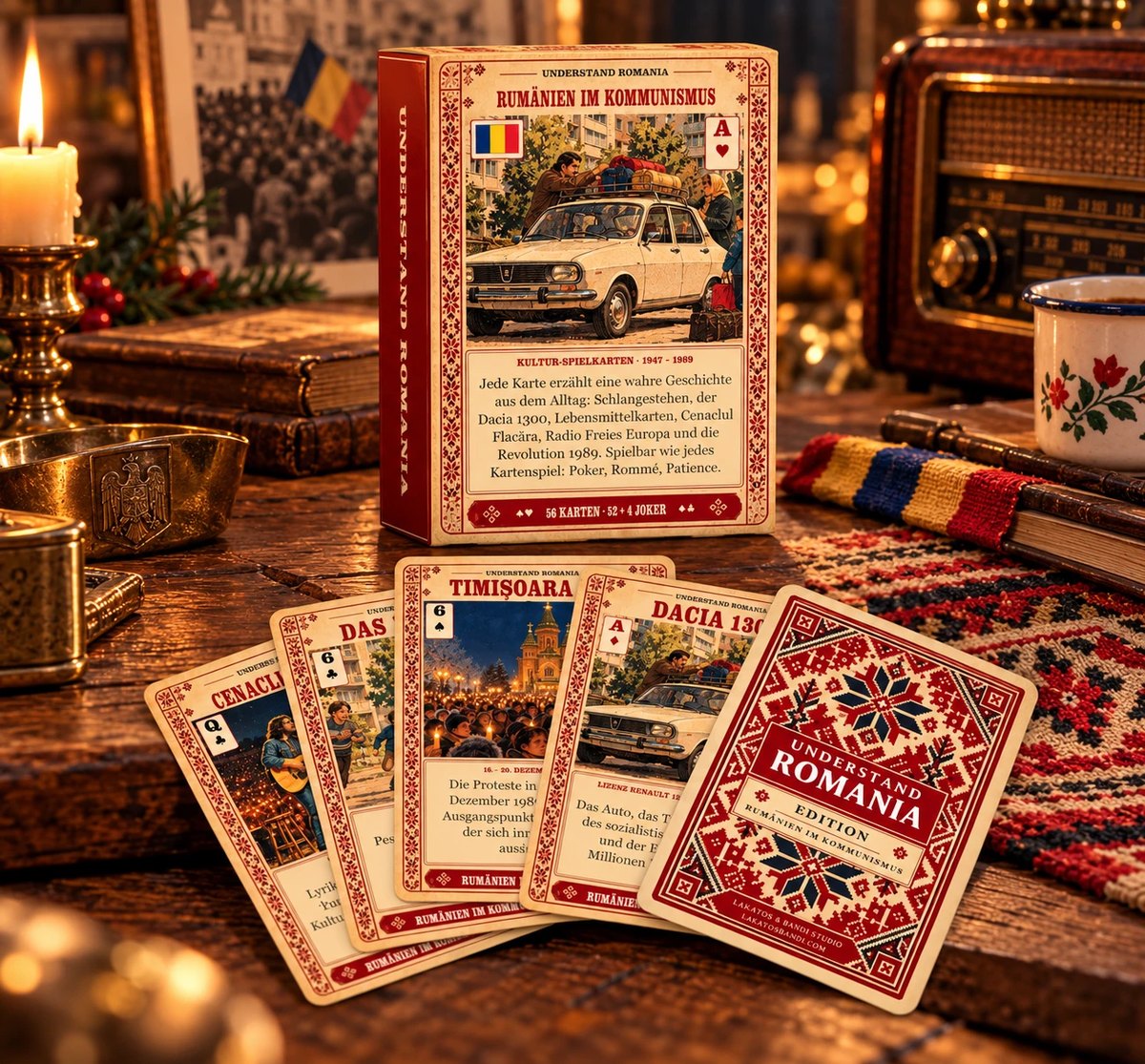
Every card tells a true story of everyday life 1947 – 1989: queues, the Dacia 1300, ration cards, Cenaclul Flacăra, Radio Free Europe and the 1989 Revolution.
Front and back
All cards
All the stories (54)
- THE CARTOONS — 1970s – 1980s. Only a few minutes in the evening. But every child in the country watched: at that hour, there wasn't a single child left in the street.
- DACIA 1300 — Renault 12 licence · built 1969 – 2004. 35 years, the same model: almost two million built. People said no one could steal yours — only the owner knew where the gears were.
- THE QUEUE — 1980s. It didn't always matter what was being sold. If you saw a queue, you joined it. Maybe "something had come in".
- COLD CUTS — 1980s. Summer salami was rare, the soy kind more common. And chicken often came only as “sets”: necks, wings and feet.
- VAMA VECHE — 1970s – 1980s. A village on the Bulgarian border, no hotels: tents, guitars and nights on the beach. People came here to be left alone.
- COSTINEȘTI — 1970s – 1980s. The youth resort: the disco, the wreck of the Evangelia on the beach and your first holiday love.
- CENACLUL FLACĂRA — 1973 – 1985. Adrian Păunescu, folk, poetry and stadiums full until dawn. In 1985 in Ploiești, rain set off a panic and people died — and the Cenaclu was banned.
- THE BICYCLE — 1970s – 1980s. The Pegas was your first vehicle. On it you left the neighbourhood — and came back only when the street lamps came on.
- WINTER AT HOME — 1980s. The radiators were cold, hot water came rarely. You slept in your clothes and did your homework in gloves.
- PETROL — 1980s. A car wasn't enough. You also had to find petrol. Like oil and sugar, petrol was rationed: a few litres a month, with coupons. On Sundays you drove by odd or even number plate.
- ALIMENTARA — 1947 – 1989. The neighbourhood state shop: shelves, queues and the daily question — "What came in?"
- THE RATION CARD — 1981 – 1989. Bread, oil, sugar, flour — on the ration card, a monthly portion per person. Lose the card, lose the month.
- EMPTY SHELVES — 1980s. Big shops, many shop windows and sometimes very few products to buy. What you could always find on the shelves: tinned fish, mustard, mineral water and peas.
- THE BLOCK — prefab panels · 1960s – 1980s. You heard the neighbour upstairs flush. You knew what the one next door was eating. And the whole stairwell knew when you came home.
- SYSTEMATIZATION — 1974 – 1989. Churches moved on rails, old neighbourhoods torn down. Grandma's house could make way for a block within a month.
- THE SECURITATE — 1948 – 1989. You never knew who was an informer: a colleague, a neighbour, sometimes a friend. Some things were said only in the kitchen, with the radio turned up.
- PROPAGANDA — Ceaușescu era · 1965 – 1989. His portrait hung in every classroom and filled every newspaper. On TV the harvests grew every year — on the shelves, they didn't.
- 23 AUGUST — national day until 1989. National day with a march past the official stand. Pupils rehearsed for weeks for a few minutes in front of it.
- THE PARADE — 1970s – 1980s. Rain or shine, attendance was compulsory. You got a flag or a placard — and smiled as you passed the stand.
- THE PARTY — 1947 – 1989. The party card opened doors: at work, at school, for a flat. Many had one without believing in it.
- GRANDMA'S KITCHEN — 1980s. Zacuscă, pickles, jam — in autumn the pantry filled up. What the shop didn't have was in grandma's jars.
- THE NET BAG — 1970s – 1980s. The shopping net was always at hand. You never knew when "something would come in".
- THE APARTMENT — 1970s – 1980s. Polished furniture, a doily on the TV, a carpet on the wall and a glass cabinet full of glasses nobody ever used.
- FROM THE FACTORY — 1980s. Everyone worked somewhere — and everyone brought something home from there. Connections were the real currency.
- FREE EUROPE — in Romanian from 1950. In the evening, ear pressed to the radio, through the jamming. The real news came from Munich — and you didn't repeat it at school.
- LEVI’S — 1970s – 1980s. A pair of Western jeans could say more about status than many other things. A pair cost about half a monthly wage.
- TEA — 1980s. Coffee was missing, tea wasn't: linden or mint, picked in summer. In every home, in the evening, with bread toasted on the stove.
- ȚUICA — 1970s – 1980s. Made at home and shared among relatives and friends, țuica remained part of social life. It was often distilled illegally, in secret, in the yard or the cellar.
- NECHEZOL — 1980s. In the years of shortage, blends and substitutes circulated in place of real coffee. It was made from roasted chickpeas, barley or chicory, with little or no coffee.
- FOREIGN CIGARETTES — 1980s. A carton of Kent opened every door: at the doctor's, the mechanic's, the counter. Many never smoked it — they just passed it on.
- THE PARCEL — 1970s – 1980s. A parcel from Germany smelled of soap and coffee from the doorway. The colourful packaging then stayed on the shelf, empty, as decoration.
- THE VIDEO TAPE — 1980s. A video player in the block was an event. Neighbours came with their own chairs, and the tape then went from hand to hand.
- THE BLACK MARKET — “bișniță” · 1980s. Jeans, coffee, cigarettes, cassettes — you could find everything if you knew who to ask. The question was always: “Do you know someone?”
- THE TELEPHONE — 1970s – 1980s. You waited years for a phone. Whoever had one had the whole stairwell at the door — and the whole stairwell heard what you said.
- FROM THE COUNTRYSIDE — 1980s. On Sunday evenings the train to town was full of bags: eggs, cheese, meat from the parents. Without relatives in the country, the fridge stayed empty.
- THE CASSETTE PLAYER — 1980s. Music recorded and copied onto tapes opened a window onto another world. A Sharp, Sony or Grundig brought from the West cost several monthly wages.
- THE UNIFORM — 1970s – 1980s. The blue uniform, the school number sewn on the sleeve and the pioneer scarf. By your number anyone could recognise you — and report you.
- THE KEY ON A STRING — 1970s – 1980s. Many children came home from school alone. The apartment key simply hung around their neck.
- SUMMER AT GRANDMA'S — 1970s – 1980s. Three months at the grandparents': barefoot, with the goats, cherries straight from the tree. You came back to town taller and tanned dark.
- THE PROMENADE — 1970s – 1980s. The holiday ticket from the trade union, two weeks at the sea and the photo by the promenade photographer — still in your album today.
- PIRATE VIDEO — 1980s. Every film had the same woman's voice translating. And everyone still knows whose it was.
- THE ESCAPE — 1970s – 1980s. The tent, the rucksack and the night train to the mountains. Up there no one could see you — and no one told you what to do.
- REBELLION — 1970s – 1980s. Jeans, long hair, rock and copied tapes could become discreet ways of standing out. For long hair, the militia could stop you in the street, take you to the station and cut it by force.
- THE END — December 1989. On 22 December 1989 the helicopter took off from the Central Committee building. After 24 years, Ceaușescu was fleeing.
- TIMIȘOARA 1989 — 16 – 20 December 1989. It all began here, on 16 December, around the house of pastor László Tőkés. The first city to shout “Down with Ceaușescu!”
- THE CUT-OUT FLAG — Timișoara, 16 – 17 December 1989. Someone cut the emblem out of the middle of the flag. The hole became the symbol of the revolution.
- THE BALCONY — 21 December 1989. On 21 December, live on TV, the crowd booed him. For the first time Ceaușescu didn't know what to say — and the whole country saw it.
- THE REVOLUTION ON TV — 22 December 1989. Television broadcast day and night. For the first time people watched history live, from their living room.
- FREE NEWSPAPERS — from December 1989. In January 1990 new newspapers appeared almost daily. People bought them all — to read what could not be written before.
- THE FIRST ADS — 1990s. The first TV ads were a show. People watched them like films — and knew them by heart.
- FOREIGN CARS — 1990s. The first Golf brought from Germany was the star of the street. The whole block came out to see it — and the neighbour's Dacia suddenly became “the old car”.
- LASĂ CĂ MERGE — 1980s. Wire, insulating tape and a bent spoon: anything could be fixed. “Lasă că merge” — “it'll do” — wasn't a saying, it was a way of life.
- THE PASSPORT — 1947 – 1989. Travel abroad was strictly controlled, and for many a passport was not an everyday object. Even to other socialist countries you could only travel with permission, and on return the passport went back to the militia.
- THE TELEVISION — 1980s. Two hours of programmes a day, much of it about him. The rest of the time the TV was a piece of furniture with a doily on top.
Pre-order yours
Game: Romania Under Communism
- You pay nothing now.
- We make first what most people ask for.
- Then you get one e-mail from us — and decide.
- Printed in Romania, in small editions. We insist on it.