Understand Romania
Romania History
56 cards · 52 + 4 jokers
Culture playing cards · First edition 2026
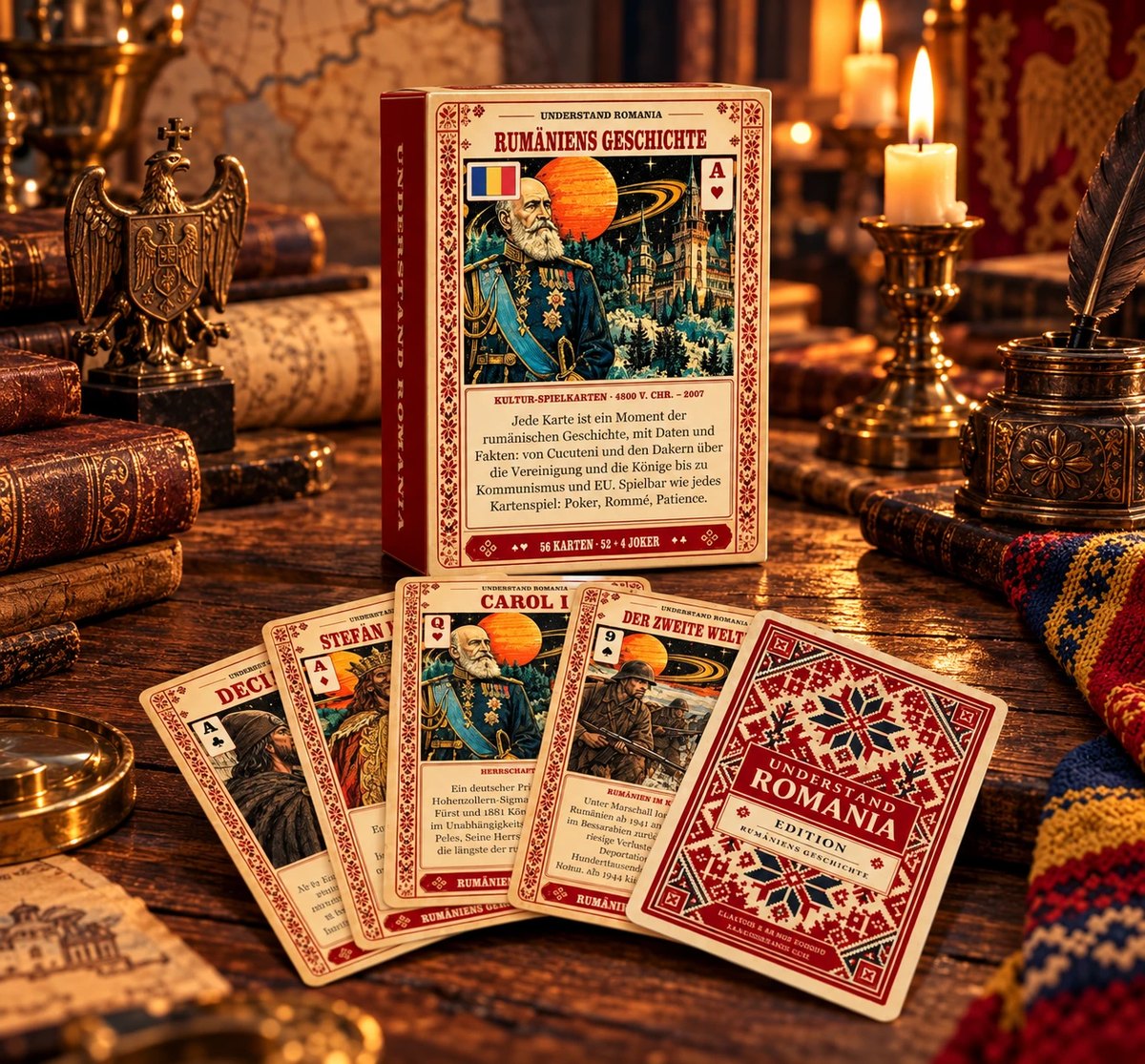
Every card is a moment in Romanian history, with dates and facts: from Cucuteni and the Dacians to the Union, the kings, communism and the European Union.
Front and back
All cards
All the stories (55)
- CUCUTENI — c. 4800 – 3000 BC. Between about 4800 and 3000 BC, the Cucuteni communities of Moldavia built settlements of hundreds of houses and painted pots with red, white and black spirals. Their pottery is counted among the most beautiful of prehistoric Europe. Many settlements were burned on purpose, and why remains a mystery.
- GETAE AND DACIANS — 6th c. BC – 106 AD. In the 5th century BC, Herodotus called the Getae "the bravest and most just of the Thracians". The Greeks called them Getae, the Romans Dacians, but they spoke the same language. They believed in the god Zalmoxis and in the immortality of the soul.
- BUREBISTA — reign c. 82 – 44 BC. Around 60 BC, Burebista united the Geto-Dacian tribes into a kingdom stretching from the Danube to the northern Carpathians and the Black Sea. His adviser was the high priest Deceneus. Julius Caesar was preparing a campaign against him, but both were killed in 44 BC.
- SARMIZEGETUSA REGIA — 1st c. BC – 106 AD. The capital of Dacia, 1,200 metres up in the Orăștie Mountains. It had temples of andesite and limestone, an "andesite sun" probably used as an altar, and walls of huge stone blocks. Today it is a UNESCO World Heritage site.
- DECEBALUS — reign 87 – 106 AD. King from 87, Decebalus destroyed the army of the Roman general Cornelius Fuscus and won from Domitian a favourable peace, with money and Roman craftsmen. He then resisted Trajan in two wars. In 106, cornered, he took his own life rather than be paraded in triumph in Rome.
- DACIAN–ROMAN WARS — 101 – 102 and 105 – 106 AD. In 101–102 and 105–106, Trajan led the largest armies of the age against Dacia. Sarmizegetusa fell, and the royal treasure — hundreds of tonnes of gold and silver, according to an ancient author — was taken to Rome and paid for huge buildings.
- TRAJAN — emperor 98 – 117 AD. Emperor from 98 to 117, Trajan brought the Roman Empire to its greatest size. At Drobeta, the architect Apollodorus of Damascus built him a bridge of stone and timber across the Danube, over a kilometre long, used by the legions in the second war.
- TRAJAN'S COLUMN — erected in 113 AD. Erected in Rome in 113, the column is 30 metres tall and its relief winds around it for almost 200 metres. It shows more than 2,500 figures: Dacians, Romans, bridges, fortresses and the suicide of Decebalus. It is the most important picture source about the Dacians.
- ROMAN DACIA — Roman province 106 – 271 AD. From 106 to 271, Dacia was a Roman province. Its capital was Ulpia Traiana Sarmizegetusa; towns such as Apulum, Napoca and Porolissum grew up. Settlers came from all over the empire, and the gold mines of the Apuseni Mountains were heavily worked.
- THE LATIN LANGUAGE — 2nd – 8th c. AD. Romanian grew out of the spoken Latin of the Danube provinces. Basic words such as "pâine" (bread), "apă" (water), "om" (man) and "casă" (house) come from Latin. Romanian is the only Romance national language in Eastern Europe.
- THE ROMAN WITHDRAWAL — 271 AD. Under pressure from the Goths and the Carpi, Emperor Aurelian withdrew the army and administration south of the Danube, where he created a new "Dacia". But part of the Romanised population stayed north of the river and went on speaking Latin.
- THE MIGRATIONS — 4th – 13th c. AD. For almost a thousand years, Goths, Huns, Gepids, Avars, Slavs, Bulgars, Pechenegs, Cumans and Tatars passed through. Some ruled for only a few decades; others left words in Romanian, above all the Slavs.
- MEDIEVAL TRANSYLVANIA — 11th – 16th c.. Between the 11th and 13th centuries, Transylvania gradually became part of the Kingdom of Hungary, ruled by a voivode. Romanians, Hungarians, Székelys and Saxons lived here. After 1541 it became an autonomous principality under Ottoman overlordship.
- THE TRANSYLVANIAN SAXONS — from the 12th c.. Invited by the kings of Hungary in the 12th century, German settlers founded towns such as Sibiu, Brașov, Sighișoara and Bistrița. They were craftsmen and merchants organised in guilds, with their own rights guaranteed in 1224.
- WALLACHIA — founded c. 1310 – 1330. The state between the Carpathians and the Danube took shape in the early 14th century. Its first capital was Câmpulung, then Curtea de Argeș, Târgoviște and, from 1659, Bucharest. Its ruler bore the title of voivode and prince.
- MOLDAVIA — founded c. 1359. According to tradition, Voivode Dragoș came from Maramureș to Moldavia, and Bogdan I made it independent of Hungary around 1359. Its capitals were Baia, Siret, Suceava and, from 1564, Iași. Its coat of arms is the aurochs head.
- BASARAB I — reign c. 1310 – 1352. The first known prince of Wallachia. In 1330, at Posada, his army defeated King Charles Robert of Hungary, trapped in a narrow mountain pass. The victory meant the country's independence.
- MIRCEA THE ELDER — reign 1386 – 1418. He fought the Ottomans at Rovine in 1395 and took part in the crusade of Nicopolis in 1396. He ruled Dobruja and the Danube fortresses. He is one of the most important princes of Wallachia.
- VLAD THE IMPALER — reigns 1448, 1456 – 1462, 1476. Son of Vlad Dracul, hence the name "Drăculea". He punished thieves and disloyal boyars brutally and in 1462 halted the army of Sultan Mehmed II with the night attack near Târgoviște. The 1897 novel "Dracula" turned him into a legend.
- STEPHEN THE GREAT — reign 1457 – 1504. He ruled for 47 years and won most of his battles. In 1475, at Vaslui, he defeated a much larger Ottoman army. He built monasteries such as Putna and Voroneț. The Orthodox Church made him a saint in 1992.
- THE OTTOMAN EMPIRE — 15th c. – 1878. Wallachia and Moldavia kept their own princes but paid tribute to the Ottoman Empire for centuries. Unlike Bulgaria or Serbia, they never became Turkish provinces. Independence came only in 1877–1878.
- MICHAEL THE BRAVE — reign 1593 – 1601. Prince of Wallachia, he defeated the Ottomans at Călugăreni in 1595. In 1599 he entered Transylvania and in 1600 took Moldavia, becoming the first ruler of all three lands. He was killed in 1601 near Turda.
- FORTIFIED CHURCHES — 13th – 16th c.. To defend themselves against raids, the Saxons fortified their churches with walls, towers and storerooms for provisions. More than 150 such churches survive. Seven villages with fortified churches, Biertan among them, are UNESCO World Heritage.
- HABSBURG TRANSYLVANIA — 1699 – 1867. With the Peace of Karlowitz in 1699, Transylvania passed to the Habsburgs. The Greek Catholic Church and Romanian-language schools appeared, and the Transylvanian School argued for the Latin origin of the Romanians. From 1867 it was part of Hungary.
- THE PHANARIOTS — 1711 – 1821. After 1711 in Moldavia and 1716 in Wallachia, the sultan appointed Greek princes from the Phanar district of Constantinople. Their reigns were short and bought, and taxes were high. Some, like Alexander Ypsilantis, still made reforms and founded schools.
- TUDOR VLADIMIRESCU — 1821. An officer from Oltenia, in 1821 he raised the pandurs and peasants against the abuses of the boyars and Phanariots. He entered Bucharest but was killed by the Greek Philiki Etaireia. His movement brought back native-born princes.
- THE REVOLUTION OF 1848 — 1848. In Wallachia, Moldavia and Transylvania, young revolutionaries demanded freedoms, the end of Roma slavery and land for the peasants. More than 40,000 people gathered on the Field of Liberty at Blaj. The revolution was crushed, but its ideas lived on.
- ALEXANDRU IOAN CUZA — reign 1859 – 1866. Elected prince in both Moldavia and Wallachia, he united the two countries. He took over the monasteries' estates, gave land to the peasants and introduced free, compulsory primary schooling. He was removed in 1866 by a palace coup.
- THE UNION OF THE PRINCIPALITIES — 24 January 1859. By electing the same prince, Alexandru Ioan Cuza — in Iași on 5 January and in Bucharest on 24 January — Moldavia and Wallachia were united. From 1862 the state was called Romania. The "Hora of Union" became the song of that day.
- BUCHAREST, THE CAPITAL — capital from 1862. From 1862, Bucharest was the capital of united Romania. In the second half of the 19th century came boulevards, the Romanian Athenaeum in 1888 and buildings on French models. The city was nicknamed "Little Paris".
- CAROL I — reign 1866 – 1914. A German prince of the Hohenzollern-Sigmaringen family, he became prince in 1866 and king in 1881. He led the army in the War of Independence and built Peleș Castle. His 48-year reign is the longest in Romanian history.
- INDEPENDENCE — 1877 – 1878. On 9 May 1877, Romania declared its independence from the Ottoman Empire. The Romanian army fought alongside Russia at Plevna, Grivița and Vidin. Independence was recognised at the Congress of Berlin in 1878.
- THE KINGDOM OF ROMANIA — 1881 – 1947. On 10 May 1881, Carol I and Queen Elisabeth were crowned. The king's crown was made from the steel of a Turkish cannon captured at Plevna. The kingdom lasted until 1947, when King Michael was forced to abdicate.
- THE CERNAVODĂ BRIDGE — opened 1895. Designed by the engineer Anghel Saligny, the Danube bridge was more than 4 kilometres long with its viaducts and at the time the longest in Europe. It linked Bucharest with the port of Constanța. According to tradition, Saligny stood under the bridge as the first test train crossed.
- BELLE ÉPOQUE — c. 1890 – 1914. In the years before the First World War, the Romanian elite spoke French, read the Paris press and built villas in eclectic style. Bucharest had cafés, theatres and, from 1894, electric trams. But most peasants still lived in poverty.
- THE PEASANTS' REVOLT — February – April 1907. Starting in Moldavia, at Flămânzi, the peasant revolt spread across the whole country against the leaseholders and harsh conditions. The army put it down violently. Estimates of the dead range from a few hundred to over 10,000; land reforms followed.
- WORLD WAR I — Romania at war 1916 – 1918. In August 1916, Romania entered the war on the side of the Entente to unite Transylvania. After heavy defeats, Bucharest was occupied, and the government and king withdrew to Iași. The reorganised army then fought successfully in Moldavia.
- MĂRĂȘEȘTI — August 1917. In the summer of 1917, the Romanian army stopped the German offensive at Mărășești, Mărăști and Oituz. General Eremia Grigorescu led the defence, and the motto "They shall not pass here!" went down in history. Free Moldavia held out to the end of the war.
- THE GREAT UNION — 1 December 1918. In 1918, Bessarabia, Bukovina and Transylvania united with Romania. At Alba Iulia, on 1 December, the Great National Assembly voted for the union of Transylvania before more than 100,000 people. Today the day is Romania's National Day.
- GREATER ROMANIA — 1918 – 1940. After the Union, Romania doubled its area and population, reaching over 295,000 km² and almost 18 million people. The 1923 Constitution and the 1921 land reform changed the country. In 1940 it lost Bessarabia, northern Bukovina, northern Transylvania and the Quadrilateral.
- KING FERDINAND — reign 1914 – 1927. Although of German origin, he chose to fight against Germany and was called "the Loyal". The Great Union was achieved during his reign. In 1922 he was crowned at Alba Iulia as king of Greater Romania.
- QUEEN MARIE — queen 1914 – 1927. A granddaughter of Queen Victoria, she nursed the wounded in hospitals during the war and became a symbol of resistance. At the Paris Peace Conference of 1919 she championed Romania's cause. She was one of the best-loved figures of the age.
- INTERWAR BUCHAREST — 1918 – 1940. Between the wars Bucharest grew fast: the Telephone Palace of 1933 was the city's tallest building, and Art Deco blocks lined the boulevards. Theatres, cinemas and cafés such as Capșa had a rich cultural life.
- CAROL II — reign 1930 – 1940. He had given up the throne for a private life but came back in 1930. He supported culture, but in 1938 set up a personal dictatorship and banned the parties. After the territorial losses of 1940 he was forced to abdicate and went into exile.
- WORLD WAR II — Romania at war 1941 – 1945. Under Marshal Ion Antonescu, Romania fought from 1941 alongside Germany to win back Bessarabia. Huge losses at Stalingrad followed, as did the deportation and killing of hundreds of thousands of Jews and thousands of Roma. From 1944 it fought against Germany.
- 23 AUGUST 1944 — 23 August 1944. King Michael arrested Antonescu and announced on the radio that Romania was leaving the alliance with Germany. The decision shortened the war, but the Soviet army entered the country and stayed. It was the start of the road to communism.
- KING MICHAEL — reigns 1927 – 1930, 1940 – 1947. He became king at 5, and again at 18. On 30 December 1947 the communists forced him to abdicate, and in January 1948 he went into exile. He only returned after 1989 and died in 2017.
- THE PEOPLE'S REPUBLIC — 1947 – 1965. After the king's abdication, the Romanian People's Republic was proclaimed on 30 December 1947. The Communist Party, led by Gheorghe Gheorghiu-Dej, took total control. Thousands of opponents were locked up in prisons such as Sighet and Aiud.
- NATIONALISATION — 11 June 1948. With the law of 11 June 1948, the state took over factories, mines, banks and transport firms. Owners lost everything overnight. In the following years houses, shops and doctors' practices were nationalised too.
- COLLECTIVISATION — 1949 – 1962. Peasants were forced to hand over their land, animals and tools to collective farms. Those who resisted were imprisoned or deported. The process ended in 1962 and changed the Romanian village for ever.
- NICOLAE CEAUȘESCU — leader 1965 – 1989. He ruled Romania for 24 years. At first he seemed open to the West, especially after condemning the 1968 invasion of Czechoslovakia. Then he built a personality cult, paid off the foreign debt through shortages imposed on the people and built the House of the People.
- THE REVOLUTION — December 1989. The flag with the emblem cut out became the symbol of the revolution — the only one in Eastern Europe in which the communist regime fell through violence. Many questions about who was shooting after 22 December still have no complete answer.
- THE TRANSITION — 1990s. After 1989 Romania moved to a market economy: private firms, kiosks and the first new banks appeared, but so did inflation, unemployment and controversial privatisations. Millions of Romanians left to work abroad.
- NATO — member since 29 March 2004. Romania joined NATO on 29 March 2004, together with six other countries. Membership ended a long period of insecurity after the Cold War. Today Romania hosts allied bases, including at Deveselu and Mihail Kogălniceanu.
- THE EUROPEAN UNION — member since 1 January 2007. Romania joined the European Union on 1 January 2007, together with Bulgaria. Romanians gained the right to work and travel freely in Europe. EU funds have paid for roads, schools and hospitals all over the country.
Pre-order yours
Game: Romania History
- You pay nothing now.
- We make first what most people ask for.
- Then you get one e-mail from us — and decide.
- Printed in Romania, in small editions. We insist on it.