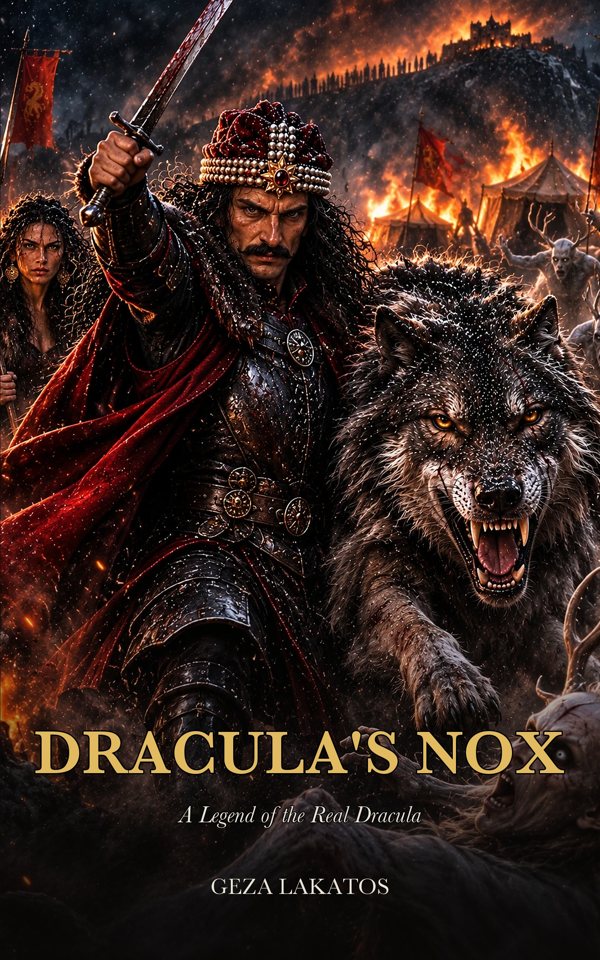
Das Buch zum Film
Dracula's Nox
Eine Legende über den echten Dracula
Walachei, Winter 1461. Die Jägerin Mara folgt der Spur eines Wolfs, den es nicht geben dürfte – klein, grau, schneller als der Wind. Sie nennt ihn Nox, die Nacht. Ein Roman über Liebe, einen Fluch und den Nachtangriff von Târgoviște, 1462.
Taschenbuch · Englisch oder Rumänisch
12,99 €
Leseprobe
A shepherd's prayer from the mountains above the Argeș
Lord, the light is going.
Keep the fire in the hearth and the door in its frame.
Keep the dead in the ground and the wolf in the wood.
Keep my sheep from the teeth and my children from the snow.
And if the night must come into my house,
let it come as a guest, and not as a curse.
And if it comes as a curse,
send someone who loves it
until it remembers its name.
Amen.
Prologue
The Night
The mountains above the Argeș, winter of 1456
The horn sounded at dusk, three times, from the far end of the valley.
The young soldier heard it from inside the hut, and he was on his feet before the third call had faded. He knew that horn. Every man who had ridden with the new Prince that summer knew it – and he had ridden closest of them all, so close that the Prince had begun to call him Lupul, the Wolf. At first because of the pelt: the grey wolfskin he wore across his shoulders, from the beast he had killed alone, with a knife, in the winter he was sixteen and the wolf had come for his father's sheep. Later, because that was what he was: silent, loyal to his pack unto death, merciless to the enemy, and unafraid of the night. It meant the same thing it always meant: come.
He took his sword from the wall. He threw the wolfskin over his shoulders. He took the cloak with the golden dragon – the sign of the house of Vlad, the son of the Dragon – and fastened it at his throat. His hands were quick and sure, as they had been so many times before.
"Don't go."
Her voice came from beside the fire. She had not moved. The light lay on her dark hair and on the small red stone she wore on her brow, and her face was very calm, the way it was calm when she sat with the sick and knew already that they would not live.
"He has called," the soldier said. "I swore an oath."
"You swore an oath to me as well. In this house. By that fire."
"That is different."
"Yes," she said. "It is."
Outside the horn sounded again, closer now. He could hear horses on the frozen road below, the ring of iron, men's voices. His friends. His brothers. Riding south, to the river and the war, as they had sworn to do.
He crossed the room and took her face in his hands. There was a scar above his brow from his first battle, and she had stitched it herself, a year ago, by the light of this same fire. She had told him then that he would carry her mark for the rest of his life. He had laughed.
"I will come back," he said.
"No," she said. "You won't. Men who ride with that Prince do not come back. They only go further." She closed her eyes. "Stay. One winter. Only one."
He kissed her forehead. Then he let her go, and turned, and opened the door into the snow.
He did not look back. Later he would think about that more than anything else – that in all the years that followed, the thing he remembered most clearly was the moment he did not look back.
❦
She came out of the hut behind him.
He had reached the edge of the trees, where the path ran down to the road. Below him the torches of the Prince's riders were moving along the valley like a slow river of fire. He raised his arm to call to them.
Her voice stopped him.
It was not loud. She did not scream, or weep, or beg. She spoke the way she spoke over her pots and her herbs, carefully, one word after another, in the old language that the monks used for their prayers and the healers for their secrets – the language of the books she had learned to read when no one else in the mountains could.
"Nox sit tibi."
The night be yours.
He turned around. She stood in the doorway with the firelight behind her, and he could not see her face.
"You love your Prince more than you love me," she said. "He calls you Lupul. His wolf. Then be his wolf. Run after him. Follow him wherever he rides. Feed where his soldiers feed. And never again sit by a fire, or sleep under a roof, or say a woman's name."
"Stop," he said.
"Until you die," she said. "Or until someone loves you more than I did. And no one will."
She was silent for a moment. Then she added, more quietly, like a last herb thrown into the fire:
"And if someone does love you, know this: even then the night will not let you go. It will find you again, and again, until your blood carries it on. You, and all of your blood. Everyone who comes after you. The night be theirs."
Then she went back inside and closed the door.
❦
It began in his hands.
They ached, then they burned, and when he looked down at them in the snow they were no longer the hands he knew. The fingers were drawing together. The nails were growing dark and long. He tried to cry out, and what came from his throat was not a cry.
He fell. The snow was cold against his face, and then it was not cold at all, because something thick and grey was spreading over his skin, over his arms and shoulders and back, and the cold could not reach him any more. His bones moved inside him. His sword slid from his belt and lay in the snow, and he could no longer understand what it was for.
The dragon cloak tore from his shoulders and fell beside it. But the wolfskin did not fall. It tightened around him, warm and alive, and grew into his flesh, until he could no longer tell where it ended and he began.
When at last it was over, he lay for a long time without moving. The world was different. The night was not dark any more; he could see every tree, every stone, every track in the snow. He could hear the horses far down in the valley, every one of them, and the creak of their saddles, and the breathing of the men. He could smell the smoke of the hut behind him, and the herbs, and the woman.
He could smell that she was crying.
He tried to get up, and fell, and tried again. His new legs would not do what he told them. They were short and thin and they folded under him like a newborn calf's, and his body was small – so small, the body of a half-grown cub – and it did not know yet how to be a wolf. At last he stood, swaying, on four legs. He went to the door and stood in front of it, and waited. But the door did not open, and after a while he understood that it never would.
❦
The Prince's riders passed below the ridge just before midnight.
They rode in a long line, two by two, with their torches held high and the dragon banner at their head. Some of them were singing. One of them – a big man with a beard, who had been the soldier's friend since they were boys – kept turning in his saddle and looking back up the path, as if he were waiting for someone who was late.
No one came.
Up on the ridge, among the dark trees, a grey wolf stood and watched them go. He was small – no bigger than a yearling cub, clumsy and thin and grey as ash – and his eyes, in the light of their torches, were the colour of amber.
He did not howl. He did not know yet that he could.
When the last torch had gone, he began to follow them along the ridge – slowly, at a distance, the way he would follow them for five long winters.
❦
Dragoș turned back at first light.
He told no one. He simply reined his horse out of the line while the others were still half asleep in their saddles, and rode back up the valley alone, the way they had come. He had waited all night for his friend to catch them up. His friend had never once been late. Not for a battle, not for a march, not for a cup of wine. Something was wrong.
The hut stood where it had always stood, at the edge of the trees, with a thin line of smoke rising from the roof. The door was shut.
In front of it, in the snow, lay a sword.
Dragoș knew that sword. He had stood beside the smith on the day it was made. He got down from his horse and picked it up, and his hands were shaking, and he did not know why.
Beside the sword lay the cloak with the golden dragon. It was torn from collar to hem, as if something had burst out of it.
And all around, in the trampled snow, there were tracks.
Not the tracks of a man. Paw prints. Small ones – smaller than a mountain wolf's – but sunk deep into the snow, and with strides between them so long that Dragoș, pacing them out, could not believe what he was measuring. They circled the door again and again, and then leading away, up towards the ridge, in the direction the army had gone.
Dragoș hammered on the door until his fist bled. No one opened it. Once he thought he heard someone weeping inside, but when he stopped to listen there was only the wind.
He searched until the sun was high. He found no body. He found no blood. He found no trace of the grey wolfskin his friend had worn across his shoulders since they were boys – and later, much later, he would wonder why that, of all things, had frightened him the most.
At last he rolled the torn cloak around the sword, tied it behind his saddle, and rode south after the army.
When the Prince asked him that evening where his wolf had gone, Dragoș looked at the ground and said what he believed.
"The wolves took him, my lord."
From that day on, he killed every wolf he met.
❦
The grey wolf did not know yet that he had a name.
But the night did.
Chapter One
Wallachia, Winter 1461
The candle had burned down to a stub, and still the Prince was writing.
Outside the walls of Poenari the wind came up from the gorge of the Argeș and threw snow against the shutters, as it had done every night that winter. Inside, in the small stone room above the gate, there was only the scratch of the quill and the soft crack of the fire. The servant who had brought the wine stood by the door and did not dare to leave, because no one had told him he could.
Vlad, son of Vlad, Prince of Wallachia by the grace of God, did not look up.
The letter was for the King of Hungary. It was long, and most of it was numbers. The servant could not read, but he could see the columns growing down the page, line after line, each one with a name at the start and a figure at the end. Villages on the Danube. Fortresses. Crossings. Giurgiu. Turtucaia. Silistra. Rahova. Places the servant had never seen and now never would, because the Prince's riders had seen them first.
At the bottom of the page the Prince wrote a last number and drew a line under it.
Twenty-three thousand, eight hundred and eighty-four.
"Not counting," he said, without turning his head, "those who burned in their houses, or whose heads were not brought to us."
The servant understood that he was not being spoken to. He looked at the floor.
The Prince read the letter through once, slowly, his lips moving as if he were tasting each word. Then he signed it. Not Io Vlad voievod, as on the charters of his own land, but with the name he used in his Latin letters to foreign kings: Wladislaus Dragwlya.
Dracula.
The name came from his father. Thirty years before, King Sigismund had taken the old Vlad into the Order of the Dragon, and from then on the world had called him Dracul – after the dragon on his chest, draco, as the Latin has it. His son, then, was Dracula. The son of the Dragon.
But the villagers below Poenari knew no Latin. In their tongue, dracul had only one meaning: the Devil. And when they spoke the Prince's name, they crossed themselves.
He sanded the ink, folded the page, and pressed his ring into the warm red wax. Only then did he raise his eyes.
They were grey eyes, the colour of river ice, and there was no anger in them. That was what frightened people most, the servant thought. Not the stakes. Not the fires along the Danube. It was that the Prince did all of it the way another man might sharpen a knife – carefully, patiently, without hurry and without hate.
"The Sultan sent me his envoys in the autumn," Vlad said. "They asked for ten thousand ducats and five hundred boys for his army. Every year. As my father paid. As my brother paid." He turned the sealed letter in his fingers. "My father is dead. My brother sits in Constantinople and eats from the Sultan's hand. And I have sent the Sultan my answer."
He set the letter down on the table.
"Now he will come himself."
He rose and went to the window, and pushed the shutter open against the wind. Snow blew into the room. The servant shivered; the Prince did not seem to feel it. He stood looking out across the gorge, towards the black ridge on the far side of the river, as if he were searching for something he had lost there.
"I had a man once," he said quietly, "who would have ridden with me into the Sultan's tent and out again. The bravest of all my soldiers. I called him my wolf. Five winters ago he rode into these mountains, and he never came back." He was silent for a while. "They told me the wolves took him."
On the far ridge, for a moment, two points of amber light shone out of the darkness – and were gone.
The Prince closed the shutter.
❦
Far below the fortress, the river ran black between walls of ice.
The road along the water was empty at this hour. No merchant travelled it any more, no shepherd, no priest. Since the autumn the road had belonged to the Prince, and the Prince had marked it as his own.
The stakes stood on both sides, hundreds of them, as far as the eye could follow the bends of the valley. In the summer, travellers said, you smelled them a day before you saw them. Now, in the deep cold, there was no smell. There was only the shape of them against the snow, dark and thin and very still, like a forest that had been planted by men.
The Turks had a name for the Prince. They said it quietly, even in their own camps, even far to the south: Kazıklı Bey. The Impaler Lord.
A small Ottoman patrol had lost its way in the snow that night. Six men on foot, their horses dead two days before, following the river because the river was the only thing they could still be sure of. They walked close together. They did not speak. When the road brought them between the stakes, the youngest of them began to pray under his breath, and no one told him to stop.
It was he who saw it first.
Something moved among the stakes. Something pale.
It was not a man. It walked like a man for a few steps, upright and stiff, and then it bent and went on all fours, and the sound it made was not a sound any of them had a word for. It stopped beneath one of the stakes and lifted its head, and in the light of the snow the young soldier saw that its head was crowned with something branching and white, like the antlers of a stag that has been dead a long time.
Then it turned and looked at them.
The six men ran.
They ran without weapons, without packs, without a thought for the direction, back along the river and into the dark. Behind them the pale thing did not follow. It had no need. It had all the time in the world, and the winter was long.
Later, much later, when the war was over and the songs about it had been sung so often that no one remembered which parts were true, the people of the valley would tell their children that the Prince's stakes had drawn things out of the forest. That the strigoi had come down from the hills to feed where the soldiers had fed. That the dead along the Argeș had not all stayed dead.
The chronicles say nothing of this. The chronicles record the Prince's war: the burned fortresses, the letters, the number at the bottom of the page.
They do not record what lived in the forests.
❦
In the mountains around Poenari people still told the old stories in the winter, when the snow closed the passes and there was nothing to do but sit by the fire and listen to the wind.
They spoke of strigoi, who rise from their graves on certain nights and walk back to the houses where they once lived. They spoke of the ielele, the women of the wind, who dance in the clearings and steal the minds of the men who see them. They spoke of creatures that wait between the trees, so still that you pass them by a hand's breadth and never know.
And they spoke, in lower voices, of a witch.
Nobody agreed on her name. Some said she had been a healer once, in a village that no longer existed. Some said she had loved a man of the Prince's family, and been betrayed. Some said she was not a woman at all, only the shape of one, and that her curse could outlast death itself – that it passed from one creature to the next like a coal carried from fire to fire, and never went out.
The old women who told this story always ended it the same way. If you ever meet a wolf in the snow, they said, look at his eyes. If they are only the eyes of a wolf, you may live. If they are something more, then run – and pray that he chooses not to follow.
The children laughed, because children always laugh at that part.
The old women did not laugh.
❦
Wolves followed the armies that winter.
They had always done so. Wherever soldiers marched there were horses that fell and did not rise, and men that fell and were not buried, and the wolves of the Carpathians had learned long ago that war was a kind of harvest. They came down from the high forests in packs of ten and twenty and fed along the Danube, and the villagers barred their doors and did not go out after dark.
But there was one wolf the villagers spoke of differently.
He was seen only at a distance, and never twice in the same place. A shepherd saw him on the ridge above Curtea de Argeș. A woodcutter saw him crossing a frozen stream near the monastery. A boy who had gone out to look for a lost goat came home white and silent, and when his mother asked him what had happened, he said only that the wolf had looked at him and then walked away, as if he had decided something.
He was the dark grey of smoke and old ash, they said, darker along the back, with a rust-brown shadow on his flanks. And he came out of the dark so suddenly that no one ever saw him coming – one moment there was only the night, and the next he was there. He was not big – smaller than the other wolves of the mountains, if anything – but he moved faster than anything on four legs had a right to move, and the other wolves themselves gave way to him. And his eyes were the colour of amber held up to a candle.
On the last night of that year, when the Prince's riders came back up the valley from the Danube with their torches burning and their banners stiff with frost, the grey wolf stood on the ridge above the river and watched them pass.
He did not howl. He did not run. He stood in the falling snow, perfectly still, and followed the line of torches with his eyes until the last of them had disappeared into the gate of Poenari.
It was the way a man watches a road he once travelled.
As if he remembered them.
Then he turned, and the forest took him back.
Wie es weitergeht, steht im Buch.
1 / 1
 ▶Den Film ansehen, mit dem das Buch begann →